
Safety for Whom? An Open Letter to the Organisers of ECER 2026, Tampere, Finland — Where At Least Twenty Complicit Israeli Institutions Are Welcome
We have noticed that the ECER 2026 conference held at the University of Tampere on August 17-21, 2026, involves participants from at least 20 Israeli institutions. Most if not all of these institutions are complicit in Israel’s apartheid regime, a crime against humanity, in what the International Court of Justice has determined is an illegal military occupation, and in Israel’s ongoing genocide against 2.3 million Palestinians in Gaza. These are atrocity crimes.
These complicit Israeli institutions include Herzog College, which maintains campuses in the illegal Israeli settlements of Alon Shvut and Migdal Oz, and Hebrew University, which is partially built on illegally occupied Palestinian land in East Jerusalem. Scholars working at these institutions are knowingly participating in a war crime.
Hebrew University additionally hosts a military base on campus and has offered its campus rooftops to Israeli forces for the oppression of the surrounding Palestinian communities in occupied East Jerusalem. Ben Gurion University (BGU) hosts the Homeland Security Institute whose partnerships include Israel’s top arms companies and the Israeli Ministry of Defense. The University of Haifa hosts three Israeli military colleges comprising the Israeli Military Academic Complex, which as the university states "form the backbone of the IDF’s elite training programs." Technion has multiple partnerships with and scholarships sponsored by Israel’s top weapons manufacturers. Bar Ilan University works closely with the Shin Bet, Israel’s notorious security services, which has been condemned by the UN Committee Against Torture for its use of torture and other illegal violent interrogation tactics.
Tel Aviv University also hosts the Institute for National Security Studies (INSS), which boasts of having developed the so-called Dahiya Doctrine, or doctrine of disproportionate force. Adopted by the Israeli military, the Dahiya Doctrine calls for “the destruction of the national infrastructure, and intense suffering among the [civilian] population.” This doctrine, which advocates for war crimes and crimes against humanity, is being employed by Israel, and not for the first time, against Palestinians in Gaza.
The complicity of Israel's academic institutions did not start or end with the ongoing genocide. Hebrew University boasts of providing “diverse logistics equipment to several military units” in active duty during the ongoing genocide. Tel Aviv University has crowdfunded for “care” packages for soldiers perpetrating the genocide and its venture capital firm, TAU Ventures, boasts of investing in Xtend, which provides systems to deploy “swarms” of armed drones that have been used in Israel’s Gaza genocide. The University of Haifa has provided equipment to soldiers carrying out the genocide in Gaza. The Open University of Israel boasts of being “the only [Israeli] institution of higher education at which soldiers on active duty in the IDF are authorized to study while serving.”
Tampere University Association of Researchers and Teachers TATTE has adopted a policy in response to the Palestinian call for a boycott of complicit Israeli academic institutions, as has the Student Union of Tampere University, the National Union of University Students of Finland, as well as a number of other student and professional organisations in Finland.
The guidelines of the academic boycott call from the Palestinian civil society-led Boycott, Divestment and Sanctions (BDS) Movement are clear—mere affiliation to a complicit academic institution is not grounds for boycott, and we believe this is a good path to follow.
However, we note that ECER 2026 does not adhere to such a principle of not boycotting individuals. The conference does not allow any participation by individuals from Russia or Belarus, or affiliated with Russian or Belarusian institutions. In fact, the conference does not even allow presentations co-authored by individuals from Russian or Belarusian institutions.
The conference’s different position on Israeli institutions and individuals from them betrays double standard and ethical inconsistency.
We also note with concern that the ECER Community Code of Conduct lists political views as a protected category, stating that exclusion based on political views is unacceptable. Conflating political positions with identity is problematic. While we commend ECER for wanting to build a safer space, we call for critical reflection on the use and abuse, even if inadvertent, of the idea.
A space cannot be safe both for those who express support for genocide and atrocity crimes and for those who belong to a group subjected to such crimes. There are Palestinian and other Arab students and scholars at the University, and as participants in the conference.
We consider it inappropriate to make assumptions about the views of any individual based on their nationality, citizenship, or home institution. At the same time, given that ECER 2026 will be hosting people from many institutions that are deeply complicit in apartheid, illegal military occupation and genocide, we feel that it is important for the conference to take necessary steps to ensure this is truly a safe and ethical space for all.
In line with their commitment to continuously reflect on and improve their practices, we therefore call on the organisers of the ECER 2026 conference to clarify publicly in conference material that the conference opposes genocide, war crimes and crimes against humanity, and that asupport or justification for such atrocity crimes is not acceptable at the conference. We further call on the organizers to publicly acknowledge the complicity in atrocity crimes of institutions listed in affiliations. We call on ECER to amend its code of conduct to remove political views as a protected category, and instead state that support for atrocity crimes is not accepted at its conferences. We call on them to include this clarification in any code of conduct messages they send to the participants, and to state it clearly in the opening speech of the conference. And finally, we call on ECER to institute an ethical conference policy to ensure a safe space for future conferences, meetings, and events.
Sumud - The Finnish Palestine Network
Reply from President of EERA to Sumud’s open letter
Thursday, August 27th, 2026
Thank you for your e-mail. Excuses for being late replying to your e-mail.
EERA and the conference ECER relate to a scholarly community, and we do not exclude anyone based on race, ethnicity or political views. Excluding institutions, and through that their members, is what a university or a country may enforce, as Finland and Finnish Universities have regarding researchers representing Russian or Belarussian Institutions. EERA follows rules and regulations in the host country of the conference, as we did for ECER 2026. EERA does not as an institution engage in or take any stance regarding political conflicts around the world. EERA has made statements regarding support for students and researchers when it related to one of our member countries. We want to reiterate the statement sent out to all ECER participants in Tampere on Wednesday Aug. 19:
“Some of the ECER participants witnessed an incident when they arrived at the social reception in Tampere Hall on Tuesday evening. A situation linked to pro-Palestinian protests in front of the venue escalated when one of the protesters repeatedly tried to enter the venue and was finally arrested by police. Being a witness to that understandably raises concerns and steers debates. We are sorry for all who were affected by what happened.
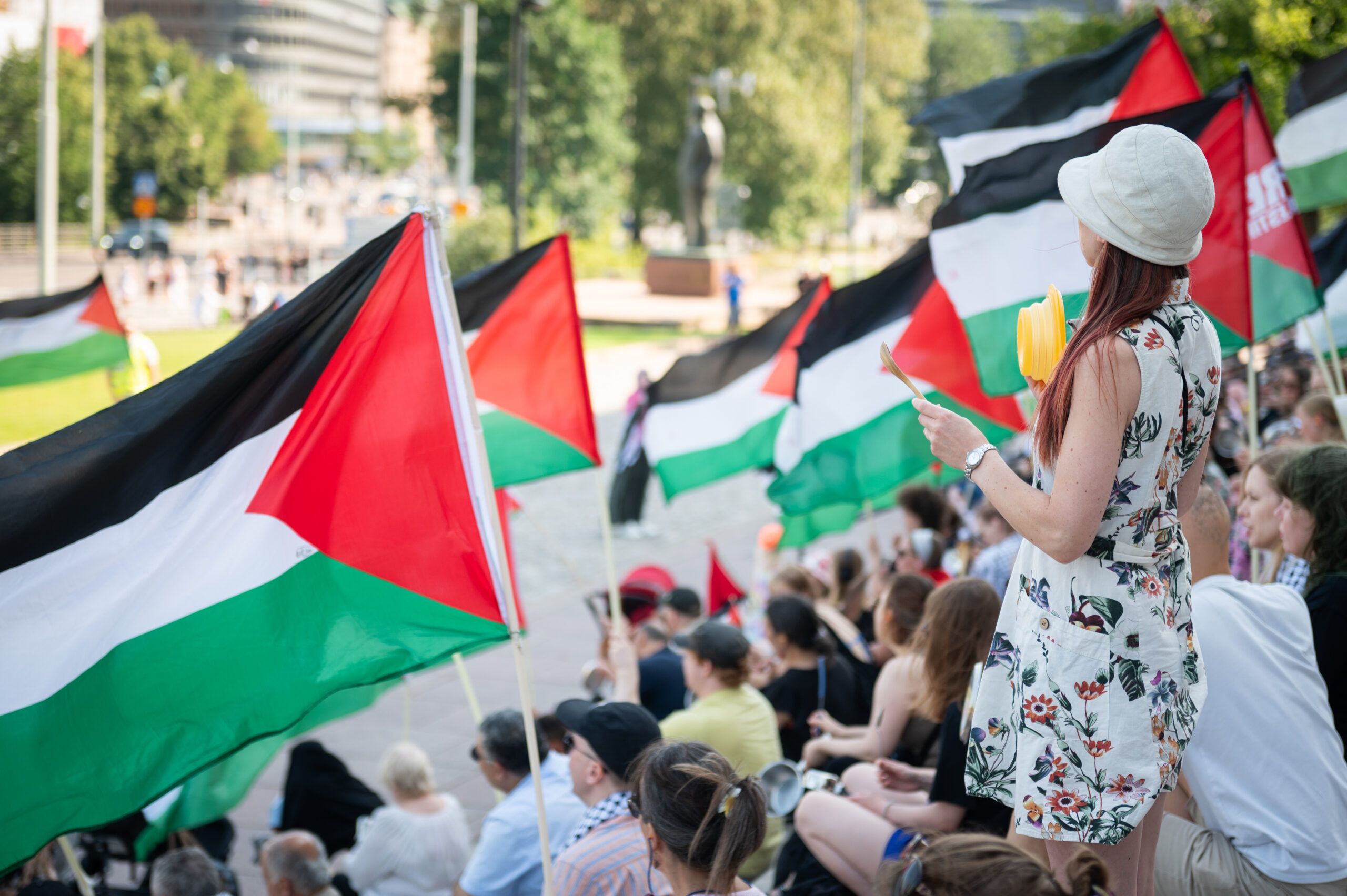
We would like to confirm that the protest as such, of course, followed all Finnish regulations and EERA fully underlines the freedom of speech and for peaceful protests. No attempt has been made to stop protests - neither from the side of EERA nor from local organisers.
As ECER brings together participants from diverse academic, cultural, and professional backgrounds, our aim is to foster an environment where knowledge is shared openly and dialogue is conducted respectfully.
EERA is and has always been sympathetic to those affected by war and atrocities; this includes the Palestinian people. Within the academic debates at ECER, we always hope for and work towards collaboration which is grounded on trust and confidence, and we count on our conference participants to follow our mission.”
Hope for your understanding,
Sincerely,
Marit H. Hoveid
On behalf of EERA executive committee
Reply from Sumud to the EERA President
Tuesday, September 1st, 2026
Dear Marit H. Hoveid,
Thank you for your response on behalf of the EERA executive committee.
You write that EERA and ECER do not exclude anyone based on political views. This statement is in contradiction with the EERA code of conduct, according to which any comments that discriminate are not allowed. Certain political views are inherently discriminatory. This includes, for example, support for genocide. Incitement to genocide is also a crime under the Convention on the Prevention and Punishment of the Crime of Genocide and the Rome Statute of the International Criminal Court.
It seems obvious to us that supporting the genocide of Palestinians or any other group is not a political position consistent with non-discrimination. We hope it is as obvious to you. If so, why would you not modify your code of conduct to reflect this?
We are surprised at the lack of commitment to concrete action, which leads us to question whether the EERA executive committee understands the gravity of the events that continue to unfold in Gaza and the depth of the complicity of Israeli academic institutions. We did not ask you to boycott Israeli participants based on their identity, but simply to condemn genocide and make clear that support for it is not acceptable. We further called to acknowledge the well-documented complicity of the Israeli institutions listed in affiliations.
You failed to do this on this occasion.
Regarding the protest at the event, your statement gives the impression that you are more concerned that a protester from Gaza wanting to draw attention to the ongoing genocide of his people at an event featuring participants from multiple institutions complicit in the genocide might make participants uncomfortable, than you are about possible support for genocide by participants and its effect on others.
We repeat our call for EERA to reform its code of conduct to make it self-consistent, by removing political views as a protected category for EERA to explicitly state that support for genocide is not allowed at its events, and to commit to acknowledging involved institutions documented as complicity in atrocity crimes in affiliations in event materials. In this time of genocide and widespread incitement to genocide, academic institutions and conferences must also carry their responsibility.
Sincerely,
Sumud - The Finnish Palestine Network